


A notched trowel in several sizes and shapes makes large tile installation more efficient.
A wet-saw with a diamond blade, the right notched trowel, and a leveling system are non-negotiable for today’s large tile. Porcelain planks now run 5 feet long and as thin as 1/8 inch, and the tools built for a 12-inch square ceramic tile in 2005 will crack, chip, or badly lip that kind of material. This guide covers the full tile installer’s toolkit, plus the specific gear large format tile actually requires, the same tools our installers rely on for real jobs around Madison.
Tile installation needs cutting tools (manual cutter, wet saw, diamond bits), mortar and trowel gear matched to ANSI A118.4 or A118.15, and layout tools like a leveling system and spacers. Large format tile, any tile over 15 inches on one edge, needs a bigger trowel, a leveling clip system, and often a second set of hands.
What’s new in large format tile installation tools
Leveling clip systems have gone from an optional extra to close to standard equipment on any real large format tile job. Porcelain planks and slabs thin enough to flex, combined with tighter flatness tolerances, mean lippage shows up fast without one.
Manufacturer guidance for large format tile now calls for substrate flatness within 1/8 inch over 10 feet and no more than 1/16 inch over any 24-inch span. That’s roughly twice as strict as the old standard-tile tolerance.
Trowel sizing has shifted too. A 3/8-inch notch that handled a standard 12-inch tile leaves too little mortar under a 24-by-48-inch plank. Installers now reach for a 1/2-by-1/2-by-1/2-inch square notch as the starting point for large format work, then back-butter on top of that for full transfer.
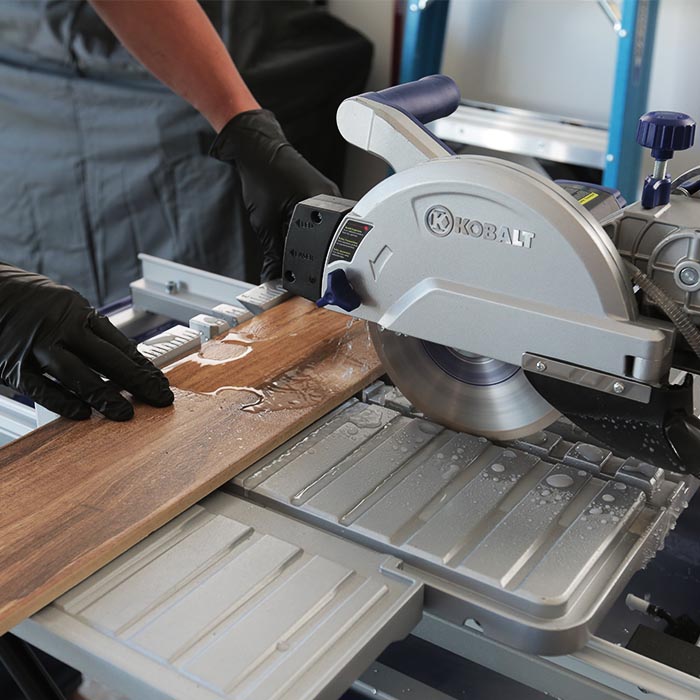
Cutting tile is a major component of large tile installation and a wet-saw with diamond-tipped blade is a must have among tiling tools.
Why large format tile needs a different toolkit
Large format tile is any tile or stone with one edge longer than 15 inches, and that extra size changes almost every step of the job. A 24-by-48-inch porcelain plank weighs several times what a same-thickness 12-inch tile does per piece, and it flexes under its own weight before the mortar sets.
That combination, more weight, more flex, less room for error, is why a standard toolkit falls short. A small trowel starves the mortar bed.
A basic level catches only one plane at a time on a tile long enough to rock across a low spot. Cutting a 5-foot plank with a manual cutter built for 12-inch tile risks a crack that ends the piece.
None of this means large format tile is only for professionals. It means the tool list is longer, and skipping items on it is where most large-tile jobs go wrong. If you want to see large format porcelain and stone in person before you buy either tile or tools, stop by our showroom in Madison.
Cutting tools: manual cutters, wet saws and diamond bits
A wet saw with a diamond blade is the one tool on this list with genuinely no substitute for cutting large format tile cleanly. Cutting hard, brittle porcelain without water and a diamond edge chips the glaze and can crack the tile outright.
- Manual tile cutter: the most-used tool in the kit for straight cuts on smaller pieces. Look for one rated for at least a 26-inch cut, and up to 60 inches for full-length plank work. A single-hand release keeps the score consistent.
- Wet tile saw: required for large format porcelain, natural stone, and any cut that needs a clean, chip-free edge. The diamond blade needs to match the tile size, and the saw needs a table long enough to support a 5-foot plank without it sagging mid-cut.
- Continuous-rim diamond blade: the right choice for glass tile and mosaic, not the segmented blade used on porcelain. Manufacturer specs for glass tile blades confirm the smooth, gap-free rim is built specifically to minimize chipping, since a segmented blade’s gaps can cause vibration and cracked edges on brittle glass.
- Diamond drill bits: for outlet boxes, plumbing penetrations, and any round cut. Wet-cutting bits run cooler and produce less dust than dry bits, and they’re worth the extra cost on large format porcelain, where a cracked hole can mean recutting the whole tile.
- Tile nippers: a hand tool for small, irregular cuts around outlets, pipes, or curved edges where a straight cutter or saw can’t reach. A standard item in most installers’ kits alongside the manual cutter.
Wet cutting isn’t only about a cleaner edge. Under OSHA’s respirable crystalline silica standard for construction (29 CFR 1926.1153), stationary and handheld masonry saws are required to use an integrated water delivery system that continuously feeds the blade.
That rule exists because dry-cutting tile and stone releases silica dust at levels that exceed the federal exposure limit, set at 50 micrograms per cubic meter over an 8-hour average. A wet saw isn’t just the better tool. For anyone cutting tile regularly, it’s the tool the law expects you to be using.
Mortar, trowels and mixing for full coverage
Large format tile needs a bigger trowel and a mortar rated for the extra weight, not just more of the same mortar you’d use on a standard tile. ANSI A118.4 covers standard modified thin-set mortar.
ANSI A118.15, the improved modified version, is the one manufacturers specify for large and heavy tile, since it resists slump on vertical surfaces and holds a fuller bed under a heavier piece.
- Mortar mixer: a drill-mounted paddle mixer with variable speed keeps mortar consistency even across a full batch. Large tile needs more mortar per piece, so a mixer that can keep pace with the job matters more here than on a small bathroom floor.
- Notched trowel: a 1/2-by-1/2-by-1/2-inch square notch is the common starting point for large format tile, sized up from the 3/8-inch notch that works fine on standard tile. Both a square-notch and a U-notch trowel are worth having, since manufacturers recommend different profiles for different mortars.
- Back-buttering: not a separate tool, but a required technique for large format tile. Coating the back of the tile with mortar in addition to combing the substrate is how installers hit full coverage on a piece too big for the trowel ridges alone to fill.
Pull a tile back up after setting it on your first few pieces and check the mortar coverage on the underside. Professional installers target close to full coverage on large format tile, since voids under a big piece are where cracks start months later.
Layout, leveling and precision tools
A leveling system holds two adjacent large tiles flush to each other while the mortar sets, not just flat to the floor individually. Lippage, one tile edge sitting proud of its neighbor, is the single most common visible defect on large-tile floors, and it’s almost always a leveling problem, not a cutting one.
- Leveling clip system: clips and wedges that pull adjacent tile edges into the same plane as the mortar cures. Rated for the tile’s weight and thickness, these have become close to standard practice on any tile over 15 inches per edge.
- Chalk line: the fastest way to confirm a room is actually square before the first tile goes down. A dry layout guided by chalk lines catches an off-center start before it turns into a sliver of cut tile against the far wall.
- Tile spacers: consistency matters more on long, plank-style tile than on small format, where a slightly uneven spacer is easy to miss. Match spacer width to the grout joint the manufacturer specifies for that tile.
Comfort, safety and cleanup tools
The tools that protect your body and finish the job cleanly matter just as much as the tools that actually set the tile. None of these are optional extras once you’re on your knees for six hours running.
- Knee pads: consistent kneeling on a hard subfloor strains joints fast. A padded, gel-lined pair is worth the cost on any floor job over a couple of hours.
- Rubber buckets: used to carry mixed mortar from the mixer to the work area. Rubber flexes enough to break dried mortar loose, where a rigid plastic bucket holds onto it.
- Rubber mallet: seats tile into the mortar bed without cracking the surface the way a metal hammer would.
- Grout float and abrasive sponge: the float spreads grout evenly into the joints, and a damp abrasive sponge clears the haze before it dries. Keep a bucket of clean water on hand, since a sponge that’s too saturated just spreads haze around instead of lifting it.
Tools built specifically for large format tile
A handful of tools exist only because tile got bigger, and skipping them is where large format jobs most often go wrong. Beyond the bigger trowel and the leveling system already covered, three more items are worth budgeting for on any job using tile over about 3 feet on its long edge.
- Suction-cup tile lifters: one 5-foot porcelain plank can be too large and too flexible to carry safely with your hands alone. Vacuum or suction-cup lifters let two installers move and place a plank without flexing or cracking it.
- Tile carrier or A-frame cart: moves multiple large tiles from the truck or the cut station to the work area. Carrying them stacked flat risks cracking the bottom piece under the weight of the ones above it.
- A second installer: not a tool, but a genuine requirement. Most manufacturers and installation guides recommend a two-person crew for any plank tile over roughly 24 by 48 inches, purely because one person can’t support both ends of the tile while it’s set.
How much does it cost to get equipped for large format tile?
Equipping yourself for a single large format tile project typically runs $300 to $1,500 in tools, before renting a saw or hiring a pro. The range depends heavily on whether you’re buying homeowner-grade tools for a one-time job or professional-grade gear you’ll use again.
- Basic hand tools (trowels, spacers, chalk line, buckets, knee pads, rubber mallet): roughly $75 to $200.
- Leveling clip system: roughly $50 to $150 for a homeowner kit covering one average room.
- Wet tile saw: $150 to $600 to buy a homeowner model, or roughly $50 to $100 per day to rent one from a tool rental supplier.
- Manual tile cutter: $40 to $250, depending on the maximum cut length.
For a one-time project, renting the wet saw and leveling system while buying the smaller hand tools is usually the better value.
Cracked plank tile isn’t cheap to replace. For a job with real risk of an expensive mistake, bringing in a professional installer who already owns the full kit and works with a two-person crew is often the more cost-effective call. Count your own time and the risk of a ruined tile before deciding to go it alone.
Common mistakes with large format tile tools
Most large format tile problems trace back to using a standard-tile toolkit on a job that needed the large format version, not to a lack of skill. Six mistakes account for the majority of callbacks and redos.
Using a 3/8-inch trowel notch instead of sizing up leaves the mortar bed too thin under a big tile, and that shows up as hollow spots and cracks within months. Skipping back-buttering on tile over 15 inches per edge is a close second, since combing the substrate alone rarely achieves full coverage on a piece that size.
Cutting large format porcelain dry, without water, chips the edge and can crack the tile outright, on top of releasing silica dust the tile saw’s water system exists to control. Working without a leveling system is another repeat offender, since lippage between adjacent large tiles is far more visible than the same slight height difference on small format tile.
Trying to carry and set a 5-foot plank solo, rather than with a second installer, cracks more large tile than any cutting mistake does. And rushing the dry layout, so cut tiles land in the middle of the room instead of against a wall, is the mistake homeowners notice every single day afterward.
FAQ
What size of tile counts as large format tile?
Large format tile is any tile or stone with at least one edge longer than 15 inches, a definition used across the mortar and adhesive industry. That covers everything from a 16-by-16 floor tile to a 5-foot porcelain plank, though the tools and techniques scale up further as the tile gets bigger within that range.
Can I use standard tile tools for large format tile?
Some tools carry over, like tile spacers and a chalk line, but the trowel, mortar and leveling system need to be sized up. A standard 3/8-inch trowel and basic level will leave a large tile under-supported and prone to lippage, even if the cut itself comes out clean.
What size trowel notch is right for large format tile?
A 1/2-by-1/2-by-1/2-inch square notch trowel is the common starting point for large format tile, compared with a 3/8-inch notch for standard sizes. Back-buttering the tile in addition to combing the substrate is standard practice on top of that trowel size.
Is it better to rent tools or hire a professional tile installer?
For a single room, renting a wet saw and leveling system while buying basic hand tools is usually cheaper. For a job where a cracked plank or a botched leveling job would be costly to fix, hiring a professional installer who already owns the equipment and crew often costs less overall.
Do I need a tile leveling system for large format tile?
Close to always, yes. Lippage, where one tile edge sits higher than its neighbor, is the most common visible defect on large-tile floors. A leveling clip system rated for the tile’s weight is the standard way installers prevent it while the mortar cures.
Can large format tile go over a concrete floor?
Yes, concrete is one of the most common substrates for large format tile, indoors or out, as long as it’s clean, structurally sound, flat within tolerance, and tested for moisture first. See our guide to tiling over concrete for the full substrate prep process and the moisture tests to run.
Verdict on equipping yourself for large format tile installation
The tools matter as much as the tile itself once you’re working with anything over 15 inches on an edge, indoors or out. A wet saw with a diamond blade, a 1/2-inch square-notch trowel, ANSI A118.15 mortar, and a leveling clip system are the four items that matter most.
Get those right and you separate a large-tile floor that lasts from one that cracks within a year.
If you’re equipping yourself for a single project, rent the expensive, occasional-use items, the wet saw and the leveling system, and buy the smaller hand tools you’ll use again. If the tile, the room, or the budget leaves no room for a costly mistake, talk to our installation team before you buy a single tool. A wrong trowel size is a cheap fix on paper and an expensive one once the mortar has already cured under a cracked plank.